
Statesboro Public Records Inventory
Georgia uses a custodian-based system. That means no single office holds all Statesboro public records. A deed and a superior-court judgment may share a clerk, but an assessment card belongs to the tax assessor, a city incident report belongs to the city, and a birth certificate follows separate vital-record rules. The table identifies the most useful keeper, the verified web route, and the fallback when the web record is incomplete.
| Records | Keeper | Web access | Copy route |
|---|---|---|---|
| Deeds, liens, plats | Bulloch Clerk of Superior Court | GSCCCA indexes; Bulloch start year unverified | Clerk email or counter |
| Superior and state cases | Bulloch Clerk of Courts | State services are not a complete free local index | Name, case number, or document request |
| Municipal cases | Statesboro Municipal Court | No verified public name portal | Phone, email, or counter |
| Property assessment | Bulloch Board of Tax Assessors | qPublic owner, address, parcel route | Assessor counter or records request |
| Probate and marriage | Bulloch Probate Court | No complete free local index verified | Probate counter or copy request |
| Birth and death | County vital office and Georgia DPH | ROVER ordering, not an open index | Online, mail, or eligible counter request |
| Police and jail | Statesboro Police or Bulloch Sheriff | No universal report index verified | Direct agency request |
Access is broad, but not absolute. Sealed court filings, juvenile and adoption material, protected personal identifiers, active-investigation details, and qualifying confidential addresses can be withheld or redacted. Georgia motor-vehicle information also follows federal privacy law. A requester should ask for the nonexempt parts instead of assuming one protected field closes an entire record.
Statesboro Records Under Georgia Law
The Georgia Open Records Act, O.C.G.A. §§ 50-18-70 through 50-18-77, begins with access to records prepared, received, or kept during public business. Any member of the public may ask for existing records, and the official guidance does not impose a Georgia-residency rule. The request goes to the office that keeps the item. An agency does not have to create a new report, summary, or custom data analysis.
Access should be immediate when practical. If production cannot occur within three business days, the agency must give a written response in that period. The reply should state a timetable, estimated cost, and the precise legal exemption for withheld material. The three-day rule governs the first response, not the final delivery of every file.
Inspection can save money. Search, retrieval, redaction, and production may be charged at the rate of the lowest-paid qualified worker, with the first 15 minutes free. Ordinary letter or legal paper is capped at ten cents per page unless another law sets the price. Prepayment may be required when an estimate exceeds $500.
Note: Ask for electronic inspection when available, a cost estimate, and only the specific pages needed from a larger Statesboro record.
Statesboro Deed Index Access
The Bulloch County Clerk of Courts keeps the county's actual deeds, liens, plats, judgments, and court files. The Georgia Superior Court Clerks' Cooperative Authority supplies separate statewide search modules for those filings. Index access and document-image access are not the same. Some features require an account or payment, and the research did not verify Bulloch's exact online start date.
Use the deed index by party role when possible. A grantor transfers an interest; a grantee receives it. Book and page or instrument details then let the clerk locate the recorded image and issue a certified copy. Plats show mapped lot or subdivision geometry, while liens identify claimants and related property or case references. The local counter remains the fallback for older books, missing images, and certification.
The official GSCCCA deed index is pictured below. Its statewide front end is useful for discovery, but a portal match should be checked against the instrument held by Bulloch County.
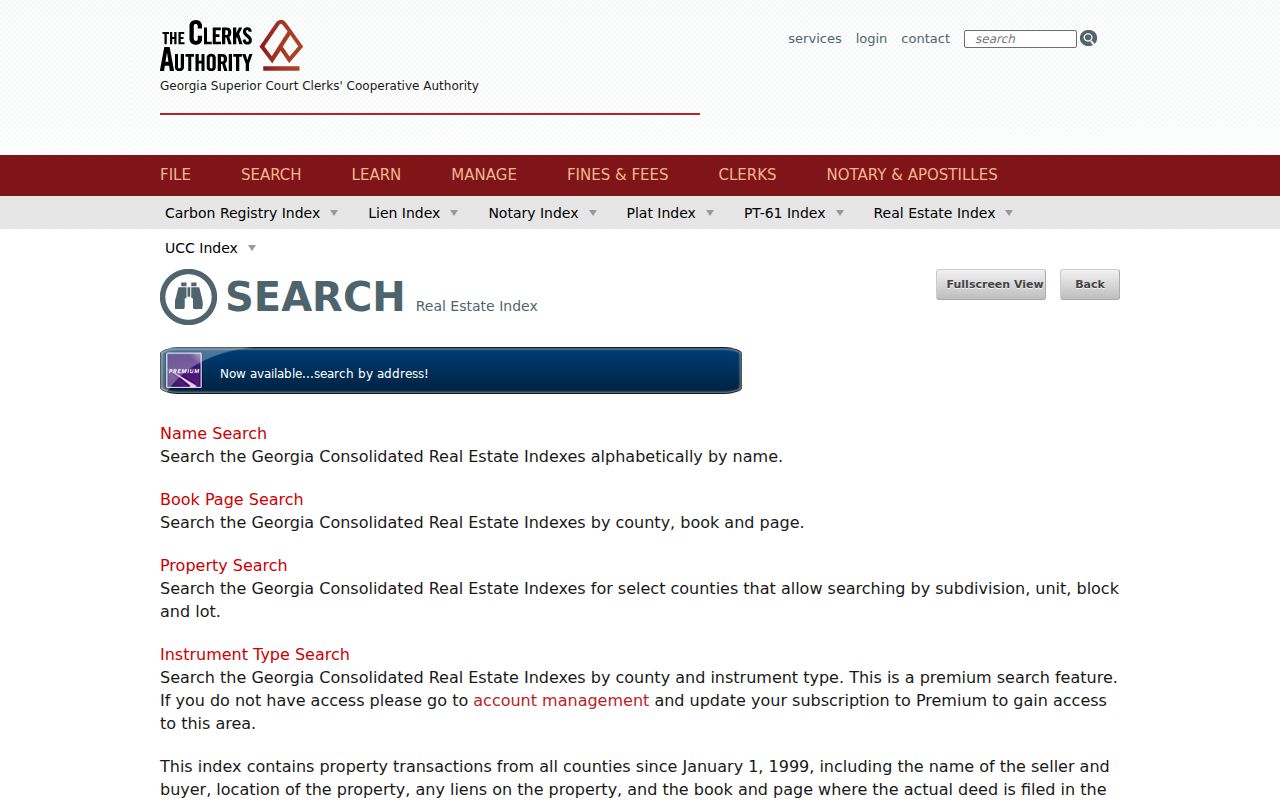
The screen illustrates why an index result and a certified deed are different products. Record the names, filing data, and book or instrument reference before contacting the clerk.
| Search detail | Use | Known limit |
|---|---|---|
| Grantor or grantee name | Find transfers tied to a person or entity | Common names require property details |
| Book and page | Request a specific recorded instrument | Usually obtained from an index hit |
| Document type | Separate deeds, liens, and plats | Modules and access terms vary |
| County | Limit results to Bulloch | Exact online coverage is not published |
Statesboro Property Records Geography
The Bulloch assessor's qPublic property search ties an owner name to the current assessment roll, parcel, location, and map. The situs address means where the parcel lies. The mailing address is where assessment notices go. Neither field alone proves that a named person lives there.
Statesboro sends zoning searches through the county parcel map. Choose a record, use “Map It,” and turn on the zoning layer. City Planning and Development should confirm the result because the city warns that online maps may not reflect every recent change. This city-to-county bridge is a local records geography feature, not a separate city ownership database.
A missing qPublic result is not proof that someone owns no land. The name may be held by an entity, the roll may reflect the January 1 owner, or protected display rules may affect identity data. Check the legal description in GSCCCA after a midyear transfer, then use the Tax Commissioner only for bill and payment context.
Statesboro Court Records Channels
Bulloch Superior Court hears felony, general civil, divorce, equity, and title matters. State Court handles misdemeanors, traffic, and civil matters within its jurisdiction. Both route record requests through the clerk at 20 Siebald Street. The clerk asks for as much identifying detail as possible and states that email requests are processed in three to five business days.
Georgia's E-Access court page routes users to provider systems, often with account requirements. It is not one complete statewide trial-court name database, and Bulloch was not found in the inspected participant list. PeachCourt is an e-filing service, not proof of a comprehensive free public docket. Ask the clerk for court, case number, party names, date range, docket sheet, filing, disposition, or certified judgment.
Statesboro Municipal Court keeps city ordinance, traffic, animal-control, and misdemeanor dockets. No general public name-search interface was verified. Contact its clerk at 22 West Grady Street, 912-764-7574, or municourt@statesboroga.gov. Federal matters instead use PACER for the Southern District of Georgia.
- Index
- A finding tool that points to a filing but may not show the document.
- Certified copy
- A custodian-authenticated copy suitable when official proof is needed.
- Custodian
- The office responsible for keeping and responding for a record.
- Exemption
- A legal rule allowing specific information to be withheld.
Statesboro Vital Records Limits
Georgia DPH holds statewide births and deaths from January 1919. The local county vital-record office can issue Georgia certificates, subject to current counter availability. Bulloch Probate Court keeps local marriage licensing, while divorce decrees come from the Superior Court clerk. State marriage holdings cover June 1952 through August 1996, so an event outside that span must go to the issuing county.
O.C.G.A. §§ 31-10-25 and 31-10-26 distinguish open indexes and county records from restricted certificate access. Birth certified copies require a direct and tangible interest. DPH says any person may order a plain-paper death record with the Social Security number removed, while certified death copies need a qualifying relationship or interest. The current state fee is $25 for the first birth or death copy and $5 for each added copy ordered together. Marriage searches cost $10, with $5 additional copies.
The Georgia death-record request page shows the available order routes and eligibility terms.
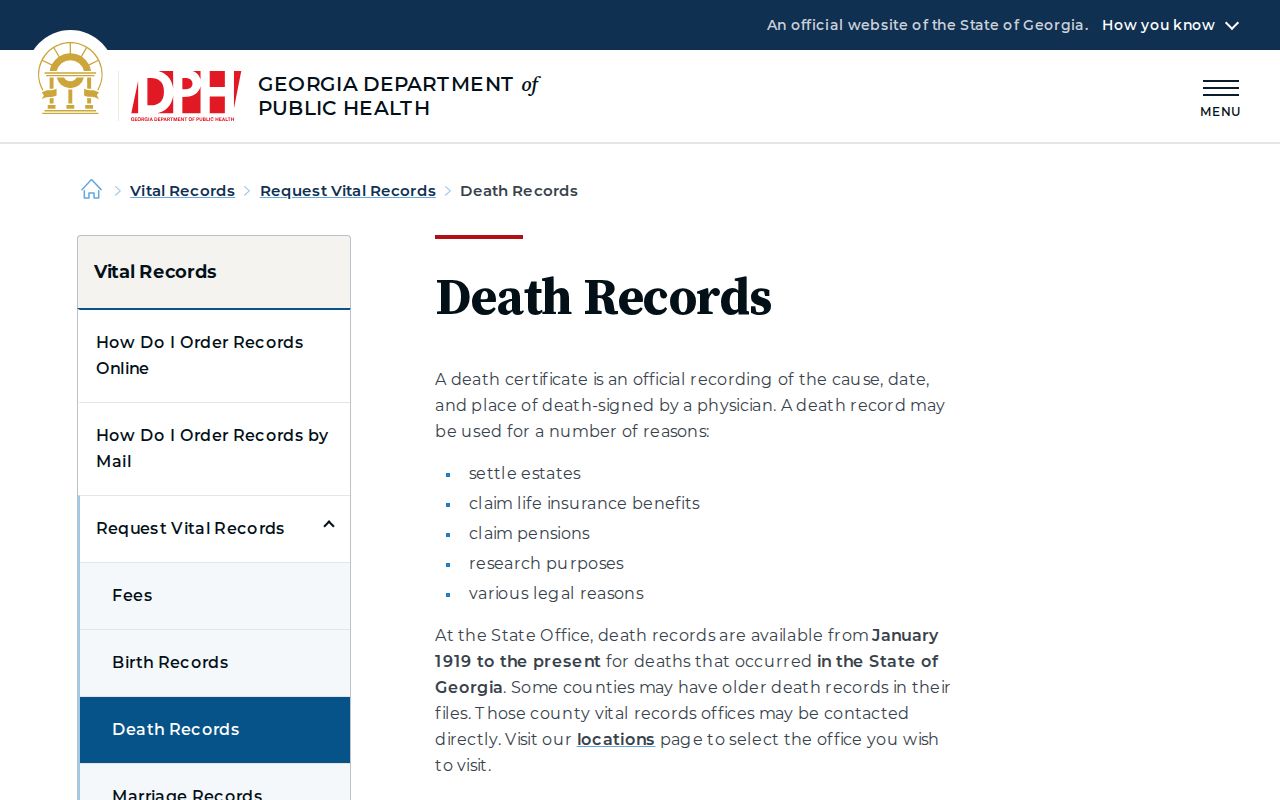
The request screen reinforces that this is an order process, not an unrestricted surname index. County of death, requester identity, relationship, and supporting documents may be needed.
Statesboro Records Offices and Portals
Choosing the right desk prevents delay. Separately elected court custodians receive their own requests, while the county commissioners' open-records officer handles Board and department material. Probate files and tax assessment data also stay with their named offices.
Bulloch Probate Court
2 North Main Street, Suite 103, Statesboro, GA
912-489-8749
County Records Officer
115 North Main Street, Statesboro, GA 30458
912-764-6245
Probate Court lists a $10 certified copy and $10 abstract fee. The county administration office publishes weekday hours from 8:00 a.m. to 5:00 p.m. Court-copy prices were not verified on the clerk page, so request a quote before ordering a large file.
Statesboro Records Across Time
Bulloch County was created in 1796, before Statesboro became the county seat in 1803 and before the permanent city charter of 1866. County land and court series can therefore predate municipal ledgers. In 1864, Union troops destroyed the log courthouse during Sherman's March to the Sea. No authoritative series-by-series loss inventory was found, so the event must not be treated as proof that every early county record vanished.
The present courthouse dates to 1894 and was renovated in 1914. Older bound volumes, microfilm, current paper files, and electronic indexes may sit in different systems. If a digital search stops, ask the clerk about the physical index and then check Georgia Archives, regional newspapers, or Georgia Southern Special Collections for a parallel source.
Ownership and occupancy also differ. A deed identifies title, while a city directory or newspaper may identify who used an address. Combining the two can help trace an estate or former family address without overstating what either record proves.
Request Statesboro Public Records
Use the Bulloch County open-records form for commissioners and county departments. It offers inspection-and-copy or copies-only choices and asks for a detailed description. Court records go to the court clerk, not the general county inbox. City police or municipal material goes to the responsible Statesboro custodian.
- Identify the office that created or maintains the record.
- Check the official index and save the exact spelling, date, parcel, case, book, or page reference.
- Request existing records within a clear date range and state whether inspection, an electronic copy, or certification is needed.
- Ask for a cost estimate and set a spending limit before staff begins extensive retrieval or redaction.
- If access is denied, request the exact statute, a redacted copy, and the nonexempt portions.
A requester may seek mediation from the Georgia Attorney General's Open Government Mediation Program or bring an enforcement action in superior court. Keep the request, delivery proof, estimates, and every response. If the first reply is vague, narrow the dates or name a specific file rather than asking the agency to assemble a new report.
Use records lawfully. Open access does not permit stalking, harassment, intimidation, trespass, impersonation, or attempts to defeat a protected address. Verify consequential facts with the custodian.